

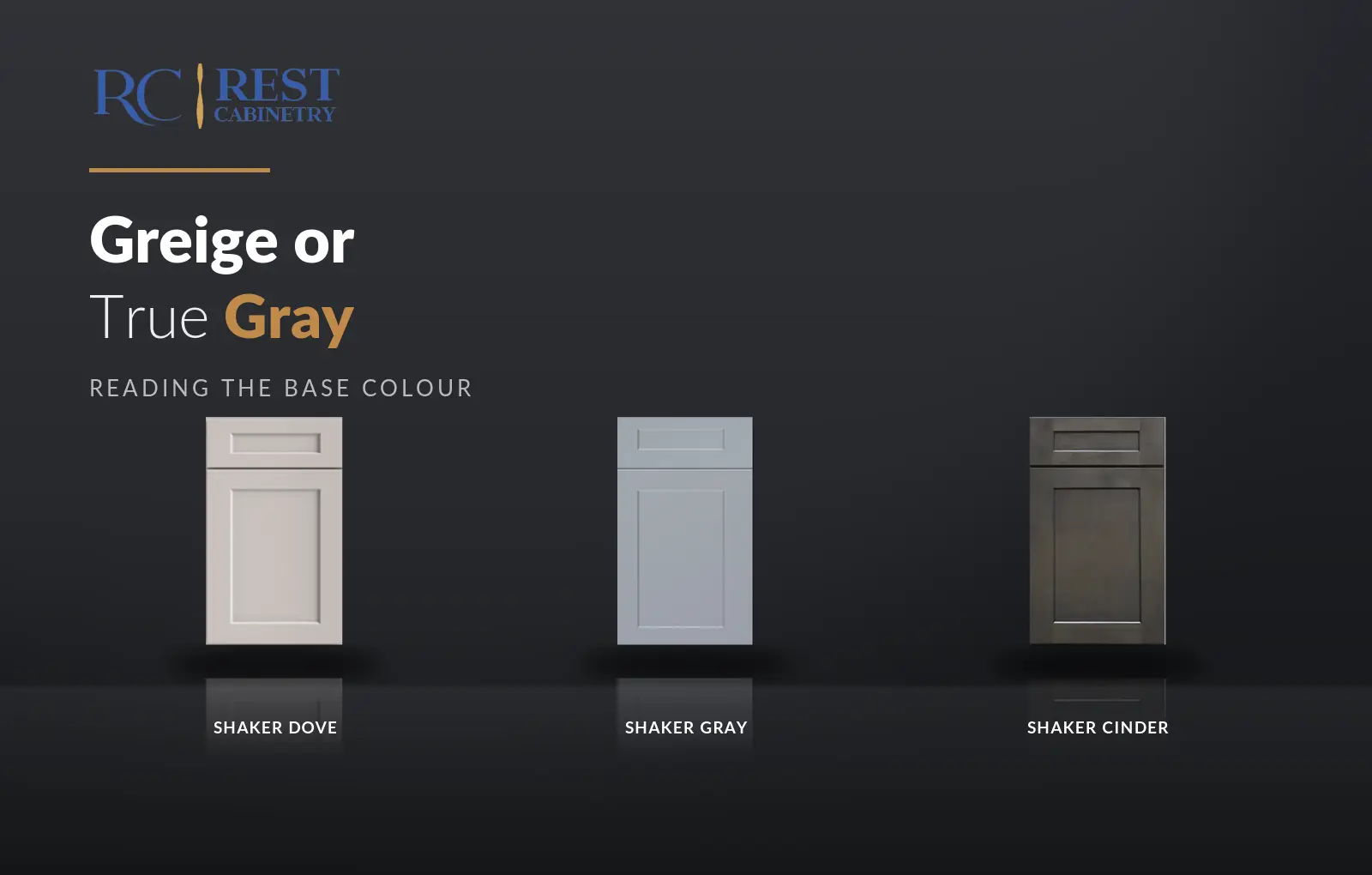
Two doors, both described as gray, both looking gray in the photograph. Put them in a kitchen and one warms the room while the other cools it. The word covering both of them is doing no work at all, so here is how to stop relying on it.
Greige has brown or beige mixed into the gray. A true gray has nothing mixed into it and stays neutral whatever the light does. Greige suits rooms with wood in them; true gray suits rooms with stone and steel.
Hold the door against a sheet of ordinary printer paper. Paper is manufactured to be as neutral as anything you own, and against it a greige reads visibly brown or tan while a true gray reads as plain gray with nothing happening.
Do it twice, once by a window and once under the bulbs you own. A door that reads greige by day and gray by night is telling you it will keep changing character in your kitchen, and that is a fact worth knowing before rather than after.
It exists to solve one problem: gray next to wood. A true gray beside an oak floor sets up a contest between a warm surface and a cold one, and the room reads as unresolved. Adding brown to the gray removes the contest.
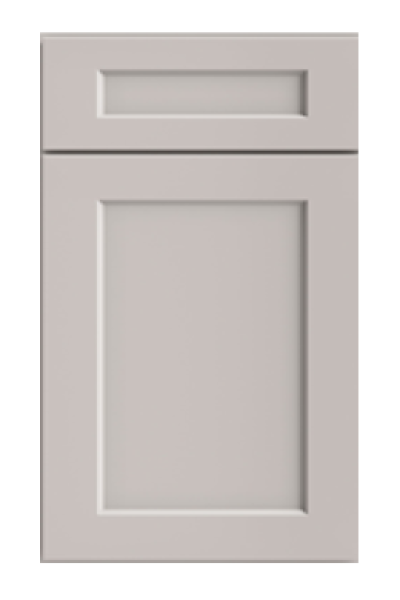
Shaker Dove is our softest greige and the easiest of all the grays to live with. Shaker Stone Wash carries more pigment and a weathered cast. Oxford Cashmere pushes furthest toward beige, to the point where people argue about whether it is a gray at all — and it holds 371 sizes, the second deepest range we carry in any finish.
The opposite room: quartz worktops, stainless appliances, a tile or concrete floor, a scheme with no timber in it. There a greige looks slightly dirty, because everything around it is cool and it is the only warm thing present.
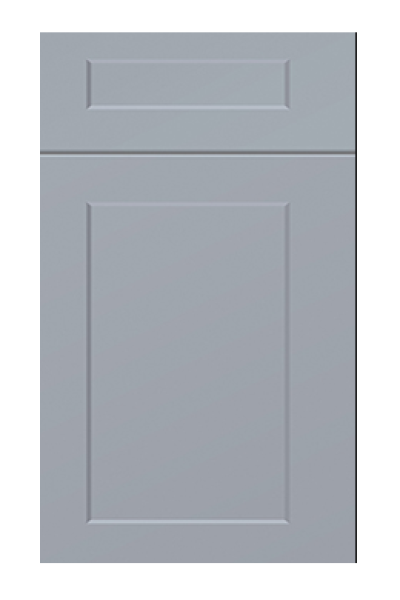
Shaker Gray is the reference point, mid-tone and unbiased. Shaker Ash Grey sits a shade lighter, Oxford Mist lighter again on a traditional door, and Franklin Grey covers the same neutrality with a moulded edge.
Beyond neutral there is a third group with blue or green under the gray. In a lit photograph these look sophisticated. In a north-facing kitchen they read as concrete, because the room is already supplying cool light and the door adds more.
Shaker Cinder sits at that end, and it is a genuinely good finish in a bright room and a cold one in a dark room. The rule is simple: the less daylight, the warmer the gray should be.
Take the floor as given, since almost nobody replaces it at the same time. Red or honey-toned oak, or any wood at all, points to greige. Grey-toned engineered board, tile, or polished concrete points to true gray. A very dark floor takes either, because the contrast is doing the work rather than the temperature.
If the floor is being replaced too, then choose the cabinets first and the floor second, because the cabinet range is narrower than the flooring range and it is easier to match a floor to a door than the other way round.
Mixing the two families in one room. A greige base run under true-gray wall cabinets is a mismatch that no amount of good hardware repairs, and it happens because the two were chosen at different times from different sources.
If a kitchen is going to use two grays, they must come from the same family and be far enough apart in depth to read as deliberate. Half a shade apart in different families is the worst of both.
Two finishes in the range sit almost exactly on the boundary, and they are the ones people confuse. Shaker Dove is a greige that most people call gray; Shaker Ash Grey is a true gray that most people call warm. Against paper the difference is obvious. Against each other it is subtle. In a finished room it decides whether the wood floor agrees with the kitchen.
If you take nothing else from this, take those two doors out together and put the paper between them.
Metal is the cheapest correction available and almost nobody uses it deliberately. Brass and unlacquered brass add warmth to whatever they are screwed to, which can pull a true gray a step toward greige without repainting anything. Matte black does the reverse and cools a greige down.
That gives a useful fallback: if a finish arrives half a shade colder than you wanted, the handles can close most of the gap. It does not work in the other direction as strongly — a greige that arrives too warm is harder to cool with metal than a cool gray is to warm.
So if you are uncertain between the two families, err toward the cooler one. It is the more correctable mistake, and on a finish like Shaker Gray or Franklin Grey the handles genuinely change the reading of the room.
Bring the floor offcut and a sheet of paper. Two doors against both, in daylight, and the argument is over. It sounds crude and it is more reliable than any amount of screen time, because the paper removes the one thing a photograph cannot: the lighting somebody else used.
Seventeen gray-family finishes are held in Norcross across six collections, and the wider question of how undertone behaves is set out in getting a gray undertone right.
Every collection below is stocked at our Norcross, GA warehouse for pickup or delivery across metro Atlanta.




The gray is on the outside. Open a door and the box is natural wood veneer...

Four finishes on one white oak door: a painted ivory, two stains and a black. What...

Wood on the island is the two-tone that people who dislike two-tone kitchens still like.
Log in to see prices and place orders
Don't have an account? Register

