


Almost every complaint about a gray kitchen is really a complaint about an undertone. The homeowner picked a gray from a photograph, it arrived, and the room went cold in a way nobody could put a name to. Gray is not a single colour. It is three families that behave completely differently once daylight touches them, and knowing which family you are shopping in removes most of the risk.
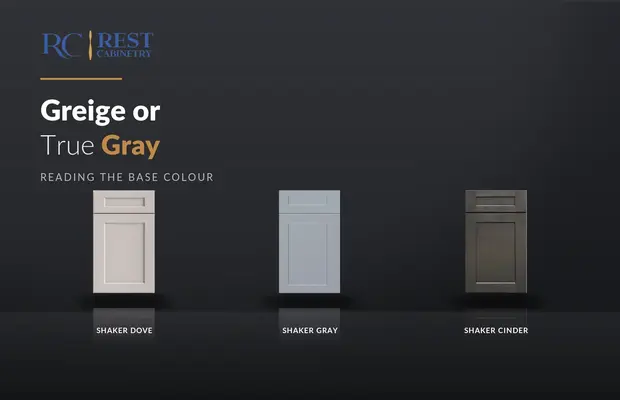
Grays divide by what is hiding underneath the neutral. Warm grays carry a brown or beige base — the family usually called greige. True neutrals carry almost nothing and stay put whatever the light does. Cool grays carry blue or green, and they are the ones that surprise people, because a cool gray that looked sophisticated in a lit studio photograph can read as concrete in a north-facing room.
None of the three is better. They simply belong in different rooms, and the room decides, not the swatch.
Greige is the family to reach for when there is wood staying in the room: a floor you are keeping, a beam, an oak table. The brown base gives the gray something to agree with, and the result reads as calm rather than cold.
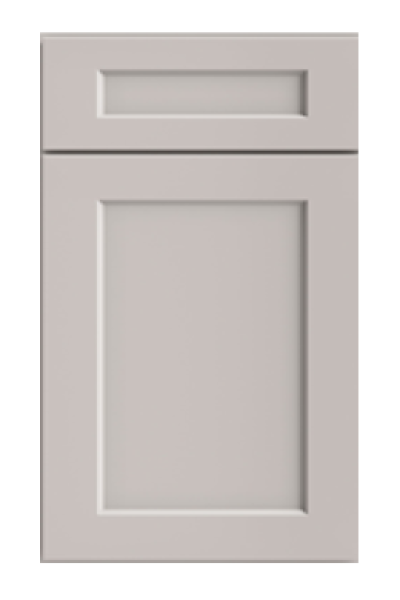
Shaker Dove is the softest of ours, barely darker than a warm white and the easiest gray to live with in a small kitchen. Shaker Stone Wash carries more colour and a faint weathered cast. Escada Dove puts the same warmth on a different door profile, and Oxford Cashmere pushes furthest toward beige — at the point where people start arguing about whether it is still a gray at all.
This is the safe middle, and the family most people actually want when they say gray. Shaker Gray is the reference point: mid-tone, no strong bias, and it holds its character morning and evening. Shaker Ash Grey sits a touch lighter and Oxford Mist lighter again on a traditional door.
For the same neutrality on a modern front, Slim Silver Gray and Slim Washed Gray use narrow rails, and the European line offers Valencia Gray and Valencia Misty Gray with no visible frame at all. Franklin Grey covers the same ground on a five-piece door with a moulded edge.
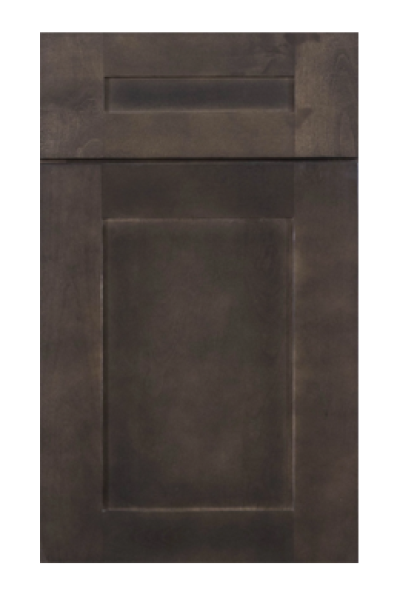
The dark end is a different decision, because a charcoal kitchen is a statement rather than a background. Shaker Dark Gray is the most usable of them — dark enough to anchor an island, light enough that a whole room of it does not close in. Shaker Cinder goes deeper and cooler.
Past that, Shaker Vintage Charcoal and Charcoal Black Shaker are effectively black in anything but direct sun, as is Matte Charcoal Black on a frameless door. These earn their keep on a lower run with something pale above; a full kitchen of them needs more window than most houses have.
There is a trick that costs nothing and settles the argument. Put the gray you are considering next to a sheet of plain printer paper. Paper is aggressively neutral, and against it the undertone stops hiding: brown, blue or genuinely nothing. Do it by the window and again under the bulbs you own at night. A gray that shifts family between those two readings is a gray that will keep surprising you after it is installed.
The second check is the floor. Cool gray cabinets above a warm-toned floor is the single most common mismatch, and it cannot be fixed later with hardware or paint. If the floor is staying and it is oak, honey or red-toned, start in the warm family and only leave it deliberately.
Gray is unusual in that it takes almost any countertop, which is exactly why it goes wrong. A white quartz with grey veining is the default pairing and it is default for a reason, but the veining has an undertone too, and a blue-grey vein above a greige door is the same mismatch in miniature.
Hardware does more work here than on white. Brass and brushed gold warm a cool gray up several degrees and are the cheapest correction available if a finish arrives colder than expected. Matte black does the opposite and pushes a mid gray toward the industrial end. Polished chrome sits neutral and disappears, which is sometimes exactly what a busy room needs.
Three ways, in order of how often we see them. The first is choosing from a photograph of somebody else’s kitchen, lit by somebody else’s windows. The second is going too dark in a room with one window, which reads as moody in the picture and cave-like in life. The third is mixing families — a cool gray base run under a warm greige wall cabinet, which no amount of good hardware rescues.
Two-tone is the exception that proves it: a deliberate contrast between a dark base and a pale upper works precisely because it is not asking two grays to look like one. That is a plan. Two grays half a family apart is an accident.
Seventeen gray-family finishes sit across six collections: Shaker holds the most, with the rest spread through Slim, Classic, Oxford, Escada and European. Each finish carries its own full size range, so choosing a gray does not narrow the layout you can build from it.
They are all held at the Norcross warehouse on Jimmy Carter Blvd, which is the only honest way to compare an undertone — three doors side by side, in daylight, against a piece of your own floor. The full range is in the cabinet catalogue, and if the room is still at the measuring stage, start there instead.
Every collection below is stocked at our Norcross, GA warehouse for pickup or delivery across metro Atlanta.




The gray is on the outside. Open a door and the box is natural wood veneer...

Most two-tone pairs are chosen from a photograph. Four of them survive a decade, and they...
Greige and gray look identical on a screen and behave nothing alike in a room. One...
Log in to see prices and place orders
Don't have an account? Register

