

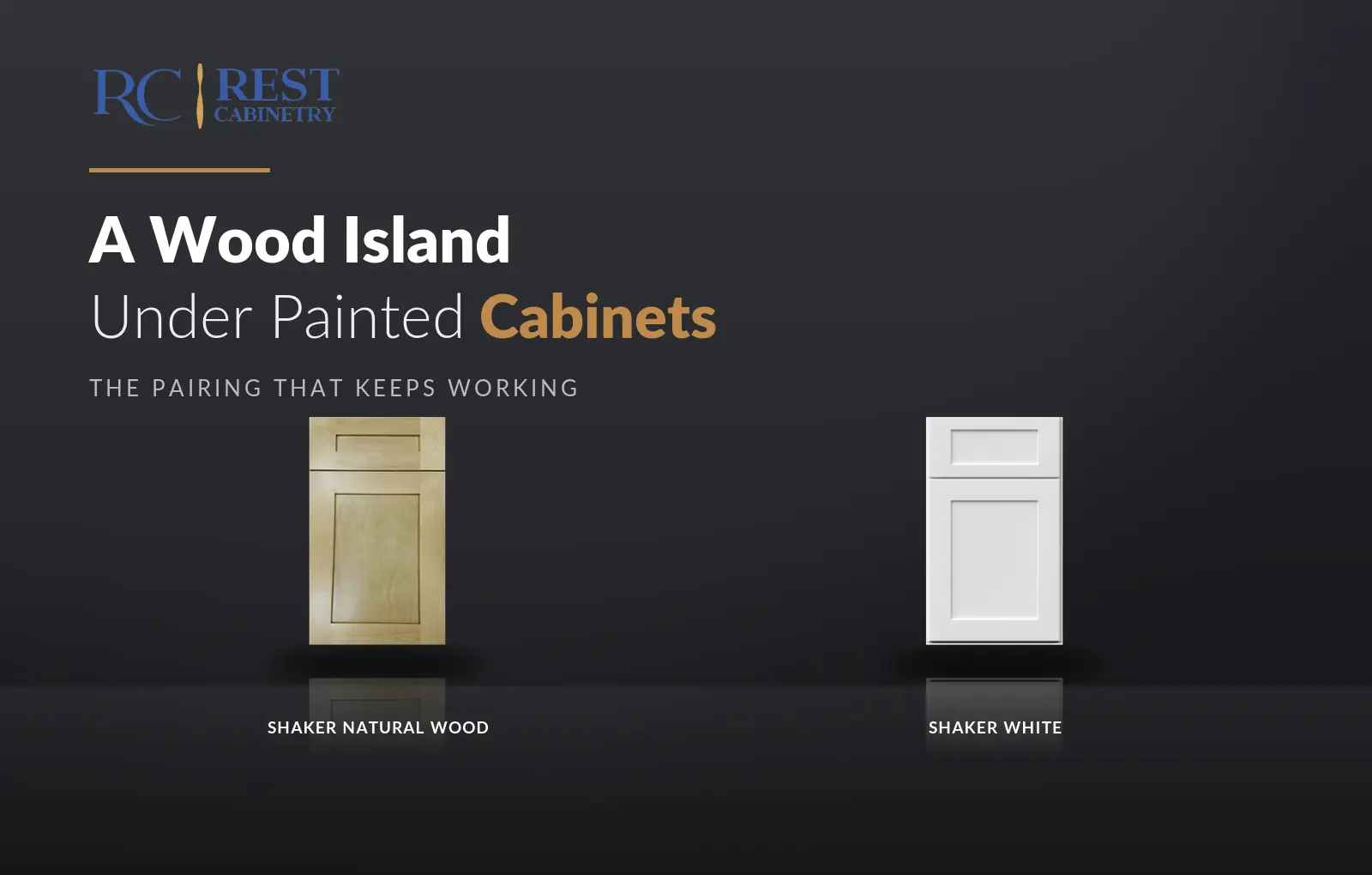
If there is one scheme that has quietly become the default in new kitchens, it is this: painted cabinets around the walls, timber in the middle. It is worth understanding why it works, because the same logic tells you how to get it wrong.
Choose a wood tone clearly different from the floor, not one that tries to match it. Everything else about this scheme is forgiving; that single decision is where it succeeds or fails.
The eye registers grain as a surface quality first and a hue second. That is why timber never competes with painted cabinets the way a second colour does, and it does not carry a decade the way a colour does.
It also does something practical: it puts a warm natural material at the centre of a room that is otherwise paint, stone and metal. Most kitchens are short of exactly that, which is why the island is where it usually lands.
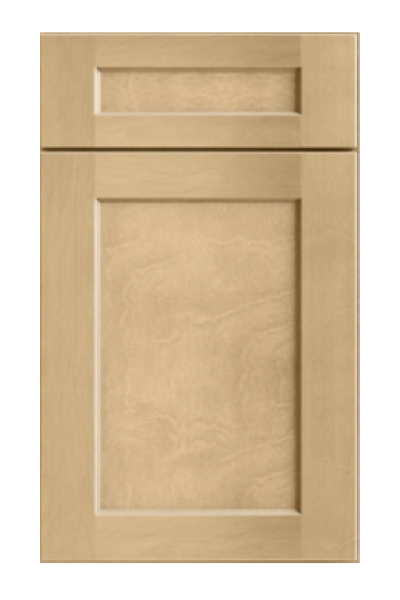
Three broad choices. Pale, such as Shaker Cotton Oak or Slim Natural, which keeps the room light and makes the island a soft presence rather than a focal point.
Mid, such as Shaker Honey or Haven Dune, sitting in the middle of the range and answering to the mental image most people already hold of this scheme.
Dark, such as Classic Chocolate or Obsidian Oak, which turns the island into the anchor of the room and behaves much like a charcoal would, with grain.
Here is the failure mode. A wood island a shade or two away from a wood floor looks like a match that missed, and that registers as a fault rather than a decision.
Go clearly darker or clearly lighter than the floor. A pale island above a mid oak floor works. A dark island above a pale floor works. A mid-honey island above a mid-oak floor almost never does, however good both are individually.
If the floor is not wood at all — tile, stone, painted concrete — this constraint disappears and any tone is available.
Anything neutral, and warmer rather than cooler. Wood is a warm material and a cold white beside it makes the timber look orange, which is the second most common complaint about this scheme.
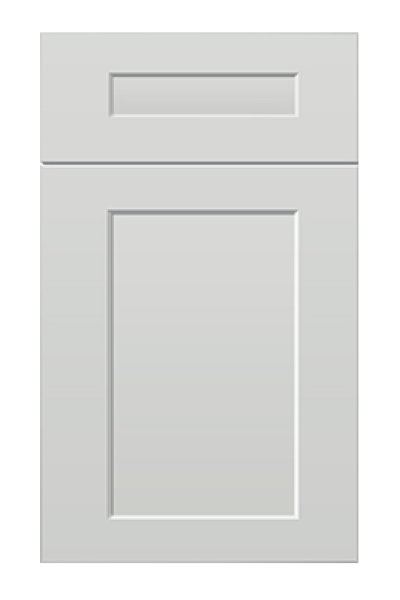
Shaker Origami White is the safe answer. Shaker Antique White if the wood is dark or reddish. Shaker Dove where the room wants a step away from white without introducing a colour.
Running the same stone across both is the calm option and lets the timber be the only change. It is also the easier one to live with, because a continuous counter reads as one worktop rather than two.
Putting a butcher block or a thick timber top on the island doubles the wood and turns the island firmly into a table. That is a strong look and it commits: the island becomes where people sit rather than where food is prepared, and the perimeter has to carry all the working surface.
One metal across both is almost always right. The island is already different in material; making it different in metal too is a second change with nothing to justify it.
Brass and bronze warm the whole room and suit the pale and mid woods. Matte black gives the timber more contrast to sit against and suits the dark end. Nickel is the neutral choice and disappears, which is exactly what you want if the wood is the feature.
Three ways. Matching the floor, covered above. Choosing a wood with heavy, busy grain and then putting a heavily veined stone on top of it, so two loud surfaces sit one above the other. And extending the wood beyond the island — onto open shelves, a hood and a pantry door — until it stops being an accent and becomes a second full finish.
Keep the timber to one object. That restraint is what makes the scheme read as considered rather than as a theme.
One detail decides whether the island looks built or applied: whether the timber wraps the ends and the back, or stops at the doors.
An island seen from three sides needs finished panels in the same wood on every visible face. Stopping the timber at the door fronts and putting a painted panel on the end is the cheap version, and it is obvious from across the room because the end panel is the largest single face of the island.
Count the end panels into the order at the same time as the doors. On a run of three or four base cabinets it is the piece most often left off the schedule and the one that costs the most to notice late.
Because the two halves fail at different rates. If the painted perimeter dates, it can be repainted in a week without touching the island. If tastes move away from the wood tone, the island can be swapped alone. Very few kitchen schemes can be renewed by halves, and that is worth more over fifteen years than any amount of being current on the day it was fitted.
Every collection below is stocked at our Norcross, GA warehouse for pickup or delivery across metro Atlanta.


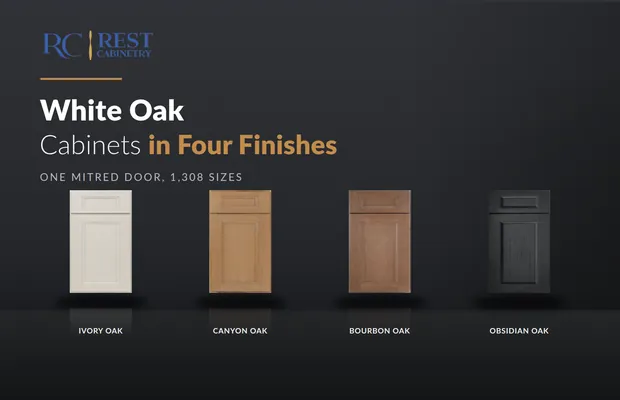
Four finishes on one white oak door: a painted ivory, two stains and a black. What...
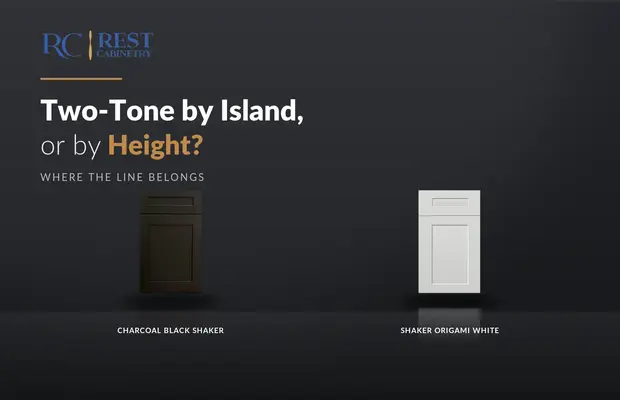
There are only two honest places to put the line. Everything else is a colour change...

Most two-tone pairs are chosen from a photograph. Four of them survive a decade, and they...
Log in to see prices and place orders
Don't have an account? Register

