

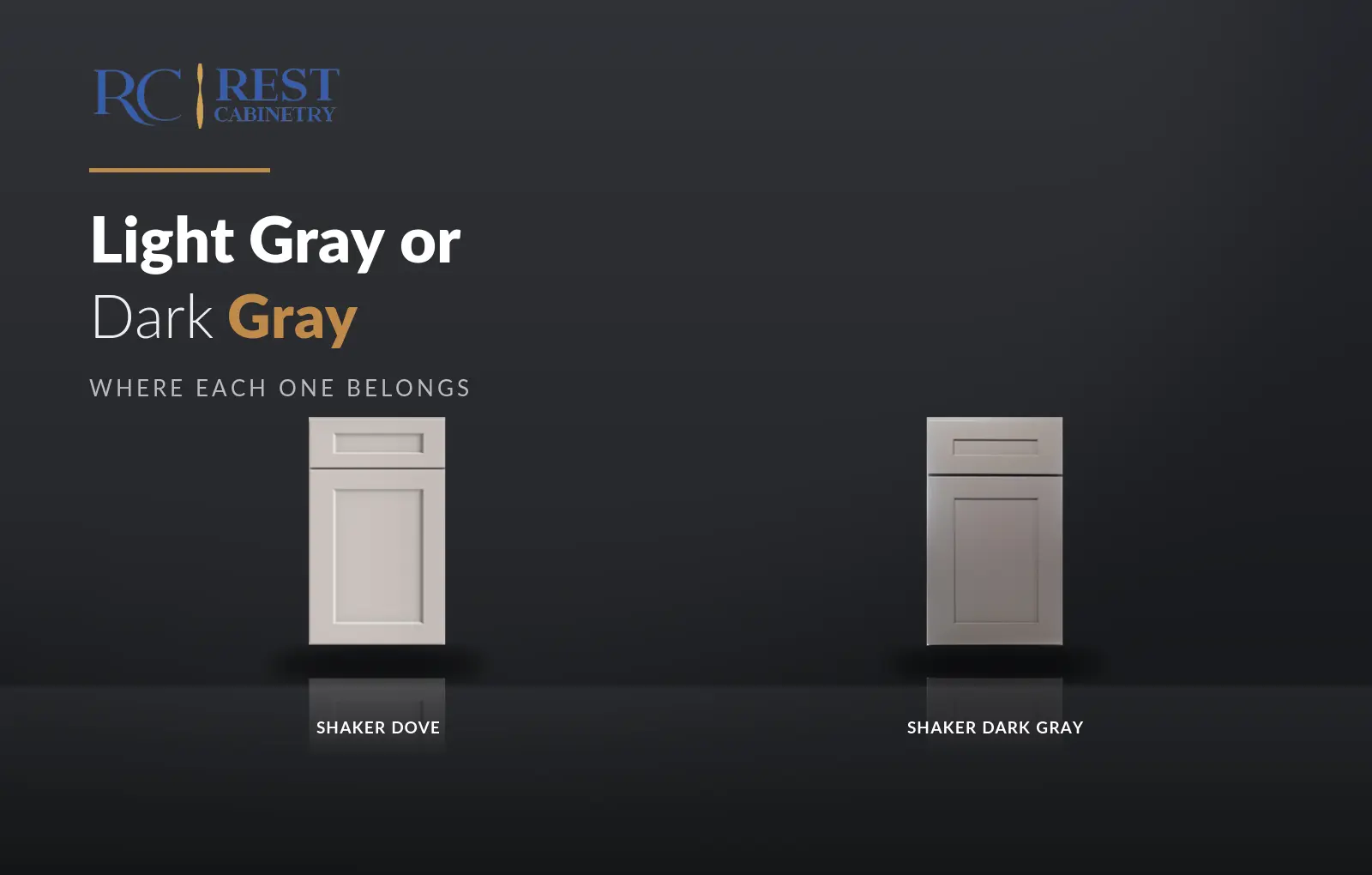
Most advice about gray cabinets is about undertone — warm, cool, neutral. That matters, but it is the second question. The first is how dark, and that one is answered by the room rather than by preference.
One window: light gray, or dark only below the counter. Two or more windows: either. High ceiling: dark works. Eight-foot ceiling and a dark floor: stay light.
A pale front returns light into the room; a dark one absorbs it. That is the whole mechanism, and it means the depth of the finish behaves like a light fitting you cannot switch off.
The effect is strongest at eye level, because that is where the fronts are closest to where you stand and where they reflect toward your face. Which is why the same dark gray reads as elegant on a base run and oppressive on a wall run.
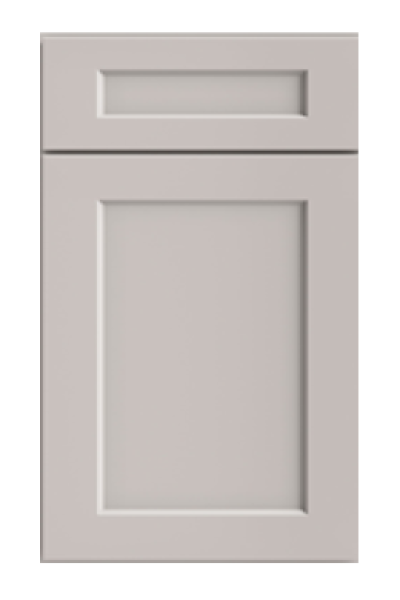
Shaker Dove sits so close to a warm white that most people read it as one, which makes it the gray for a room that cannot afford to lose light. Shaker Ash Grey and Oxford Mist sit just below it, and Slim Silver Gray does the same on a narrow-rail door.
These finishes are forgiving in a way the dark ones are not: they show less dust, they photograph well in a poor room, and they never make a small kitchen smaller.
Shaker Gray is the middle, and the middle is underrated. It is dark enough to read as a colour decision rather than as a failed white, and light enough that a whole kitchen of it stays comfortable.
If somebody wants gray and has not thought about the room yet, this is the finish that will disappoint them least.
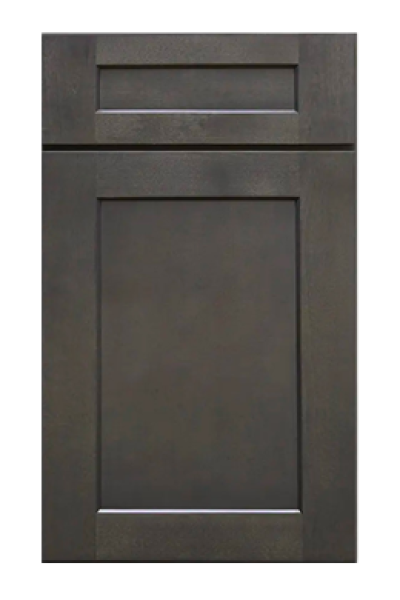
Shaker Dark Gray is where the finish starts anchoring a room rather than sitting in it. Shaker Cinder goes deeper and cooler, and beyond those the range becomes effectively black.
A dark gray base run under pale wall cabinets is the safest way to use this end, and it is safe because the two bands are doing different jobs: weight at the floor, light at eye level.
At eight feet, dark wall cabinets bring the ceiling visually down, and in a room that is already low that is the difference between cosy and cramped. Above nine feet the same cabinets do something useful: they stop the room feeling like a hall.
So the same finish is a mistake in one house and the right call in another, and the deciding number is not on any swatch.
Dark floor plus dark cabinets fuses everything below waist height into a single mass, which is a deliberate look and a heavy one. A dark floor with light cabinets is the classic and it never fails. A pale floor takes dark cabinets easily, because the contrast lands where the eye expects it.
The combination to avoid is mid-tone on mid-tone. Nothing is wrong with it and nothing is right with it either; the room just never resolves.
The most reliable way to use both ends is to put them in the same kitchen, which sounds like avoiding the question and is actually the answer most people arrive at. Dark below, light above: weight at the floor, light at eye level, and every advantage of both depths in the place where it does the most good.
Done with two finishes from the same family — Shaker Dove above and Shaker Dark Gray below, say — it reads as one considered scheme rather than as two decisions. Done across families, it reads as a compromise.
The one thing it needs is a clear line. Switch depth in the middle of a continuous run and nothing explains why; that lands with a viewer faster than any mismatched colour does.
There is a practical consequence to depth that has nothing to do with looks. Inside a dark cabinet you can see less. A pale interior bounces what light gets past the door; a dark one absorbs it, and the back of a base cabinet becomes genuinely hard to search.
Some dark finishes are built with a pale interior for exactly this reason — Shaker Gray is one, with a natural interior behind a grey front. Where the interior matches the front, the answer is drawers rather than doors in the base run, because a drawer brings its contents out to the light instead of asking you to reach into the dark.
Across our 4,942 base units the three-drawer bases are the largest single group, and this is part of why.
Stand a door where the cabinets will go and leave it there for a day. Look at it over breakfast, again in mid-afternoon, and once more at night under your own bulbs. Depth is the property that changes most between those three moments, and a fifteen-second look in a warehouse cannot show it.
If the door only looks right in one of the three, it is the wrong depth for the room, whatever it does to you in the picture.
One more check costs nothing and catches the rest. Prop the door where the wall cabinets will go rather than on the counter, because the two positions receive completely different light. A finish that reads perfectly at worktop level can read a full shade darker at head height, and the wall run is the band a visitor sees first from the doorway.
Every collection below is stocked at our Norcross, GA warehouse for pickup or delivery across metro Atlanta.




The gray is on the outside. Open a door and the box is natural wood veneer...

There are only two honest places to put the line. Everything else is a colour change...

Most two-tone pairs are chosen from a photograph. Four of them survive a decade, and they...
Log in to see prices and place orders
Don't have an account? Register

