

Every two-tone kitchen is one of two schemes wearing different colours. Either the island is different from everything else, or the lower band is different from the upper one. Choosing between them is a decision about the room, and it should be made before any finish is looked at.
Island split for an open-plan room. Height split for a closed kitchen, a galley, or any room with a low ceiling. If the room has neither an island nor much wall, it probably wants one finish.
An island is already a separate object standing in the middle of a room. Giving it a different finish does not invent a division; it describes one that is physically there, and the eye accepts it instantly.
It also solves a problem specific to open plans. In a room where the kitchen faces a living space, the perimeter is background and the island is furniture. Treating them as two things is not decoration, it is an accurate reading of what each is doing.
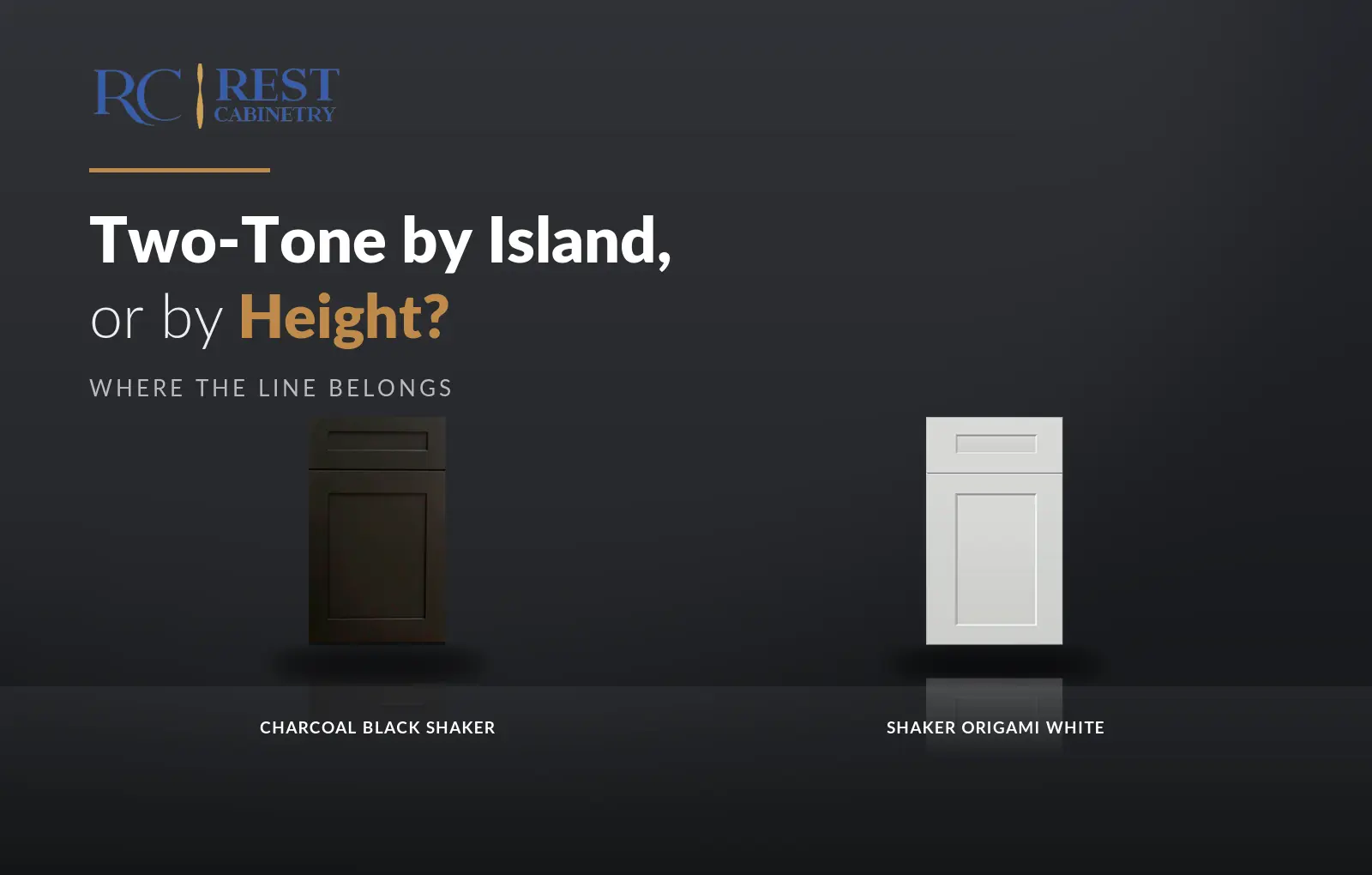
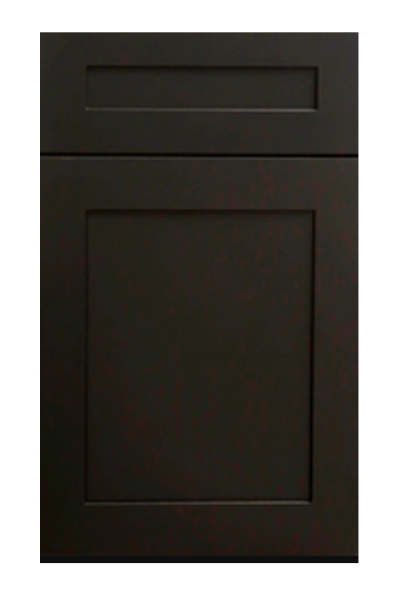
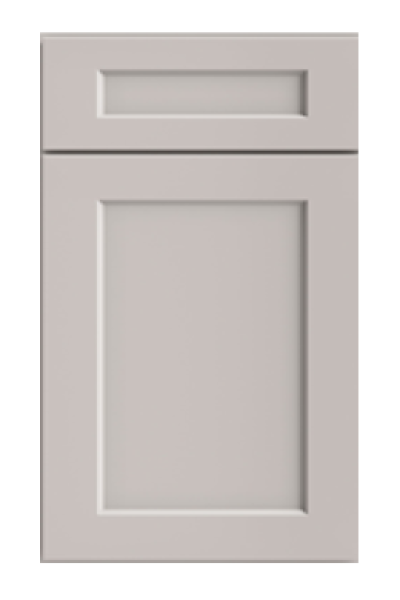
The usual arrangement is a quiet perimeter with weight on the island: Shaker Origami White around the walls and Charcoal Black Shaker or Escada Midnight Blue in the middle.
A kitchen is two bands with two different jobs. The lower band takes knocks, holds heavy things and is seen at an angle. The upper band is at eye level and is what a room borrows light from.
Making the lower band darker agrees with both facts at once: weight at the bottom where the eye expects it, and reflectivity at the top where the room needs it. That is why the arrangement looks natural rather than styled, and why it works in rooms with very little daylight.
Shaker Dark Gray below and Shaker Dove above is the version of this we are asked for most, because it stays within one family.
Three questions settle it. Is there an island large enough to read as its own object — not a small trolley, but a real run of cabinets? Does the kitchen open onto a living space that sees it? And how high is the ceiling?
Yes, yes and any height points to the island split. No island, or a closed room, or a ceiling at eight feet points to the height split. A galley with cabinets on both walls and no island has only one option, and it is height.
It is possible and it is where two-tone becomes three-tone by accident. A dark island, a dark lower run and pale wall cabinets is three surfaces in two colours, which is fine. A dark island in a third finish, on top of a height split, is three colours — and three colours in one kitchen needs a very good reason and a very large room.
If both splits are wanted, use the same dark finish for the island and the lower run. The room then reads as one decision seen twice.
With an island split, the counter usually runs continuously across both finishes, which ties the room together and lets the island colour be bolder. Some kitchens deliberately change the island counter too — wood on the island, stone on the perimeter — and that is a strong look that commits the island to being a table as much as a worktop.
In a horizontal split the counter falls right on the boundary, so it inevitably takes sides. A pale counter belongs to the upper band and makes the lower run a plinth; a dark counter belongs to the lower band and makes the bottom half one mass.
The island split fails when the island is too small to carry a second colour, at which point it reads as an object somebody forgot to finish. It also fails in a room where the island is seen end-on from the main doorway, because then almost none of the second colour is visible and the effort is invisible.
The height split fails when the contrast is too low. Two finishes half a shade apart read as a mistake rather than a decision, and the fix is more contrast rather than less.
Enough that somebody would describe the kitchen as two colours without being prompted. If a visitor has to be told, there is not enough contrast to justify the complication and one finish would have looked better.
That is the whole test, and it is more useful than any rule about shades. It also explains why the safest pairings are pale-against-dark rather than two mid-tones.
There is a practical difference nobody mentions. An island split needs the second finish in only a handful of units — typically three or four base cabinets and an end panel. A height split needs it across every base cabinet in the room.
That matters when one of the two finishes has a narrower range. A finish with 215 sizes such as Classic White will cover an island comfortably and may run short across a whole lower run in an awkward room, where something like Oxford Cashmere at 371 sizes or Valencia White at 429 has far more room to manoeuvre.
So the split you choose quietly changes which finishes are safe choices. Check the narrower of your two against the plan before the pairing is fixed.
Room shape first, which picks the split. Then the dark finish, because it carries the kitchen. Then the pale one, whose only job is to disappear. Then the counter, which has to belong to one band. Then hardware.
Reversing any of those steps produces a kitchen that was assembled rather than designed, and the difference is visible from the doorway even to somebody who could not explain it.
Every collection below is stocked at our Norcross, GA warehouse for pickup or delivery across metro Atlanta.




Wood on the island is the two-tone that people who dislike two-tone kitchens still like.

Most two-tone pairs are chosen from a photograph. Four of them survive a decade, and they...

A two-tone kitchen fails in five predictable ways. All five are visible on paper before anything...
Log in to see prices and place orders
Don't have an account? Register

