


A homeowner buys one kitchen and cares most about the colour. A builder buys the same kitchen repeatedly and cares most about whether it can be bought again next quarter without a phone call. Those are different purchases from the same rack, and the questions worth asking are different too.
For repeat work, the number that matters is not the price of a door but how many sizes stand behind it. A finish with 300-odd sizes will absorb an awkward wall without a special order; one with a short range will force a redesign on the second house.
The range here runs to 20,889 individual sizes across nine collections. Within that, the depth varies a lot by finish, and it is worth knowing which end you are specifying from before a plan is drawn.
Against those, Classic White holds 215 and Matte White 181. Neither is a worse cabinet; both are a narrower net, and on a spec-build that difference shows up as a filler where you wanted a cabinet.
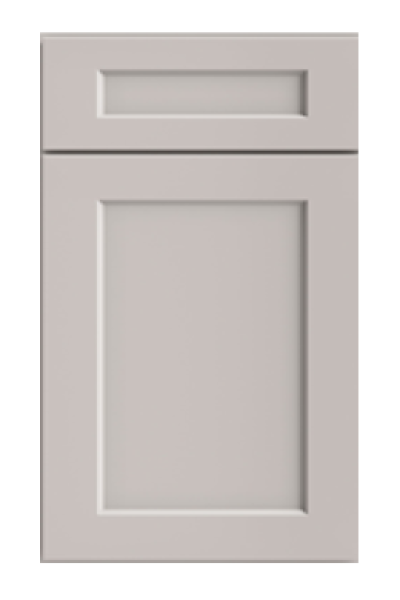
The most expensive mistake on a multi-unit job is standardising on a finish that turns out to be thin on stock. It costs nothing on house one and a redesign on house four.
Two questions settle it: how many sizes does this finish actually carry, and is it a core line rather than a seasonal colour. The Shaker collection is the safest ground on both counts — 21 finishes and 6,463 sizes between them — with Classic and Oxford next.
Cabinet schedules are usually accurate about cabinets and vague about everything else, and everything else is what holds a job up on the last afternoon. Before a package is priced, make sure the count includes fillers at every wall and every corner, finished end panels wherever a run stops in the open, toe kick for the whole perimeter, crown or light rail if the design has it, and scribe moulding for the walls that are not straight.
On a run of any length these are not a rounding error. They are the difference between finishing on Friday and finishing the following Wednesday.
Boxes can be put together away from the live site — in a garage, a week ahead, by whoever has an hour — which on a multi-house job turns a task into slack. The trade-off and what actually differs are set out in what ready-to-assemble means.
The practical rule: unwrap and count on arrival, never on the morning the fitter needs them. Anything missing that surfaces three weeks out costs nothing at all.
On anything phased across months, agree a second finish at the same time as the first and write it into the spec. Not because stock is unreliable, but because one width in one finish will eventually be the thing standing between a crew and a finished run, and a decision already made costs nothing on the day.
Pick the pair so they are interchangeable in the room, not merely similar on paper: two whites of the same warmth, or two neutrals from the same collection. Shaker Origami White with Shaker White is a workable pair; a warm white with a cool one is not, and the difference will be visible in every unit that was substituted.

Three things are worth confirming before a number goes to a client. That the piece count is complete, including the trim items above. That the finish carries every size on the drawing rather than most of them. And that the delivery date is the date on site, not the date it leaves a rack.
A package priced without those checks is not a cheaper package. It is the same package with its problems pushed to the end of the job, where they cost more, take longer, and happen in front of the client.
On renovation work in older Gwinnett houses, framed construction absorbs walls that are out of true and will cost less labour to fit straight. On new construction, where the walls are plumb, frameless gives wider openings for the same nominal cabinet. Specifying the wrong one for the site is a labour cost, not a materials one — the comparison is in frameless versus framed.
Wall lengths and appliance openings per unit. The finish, with a second choice already agreed in case the first is short for one size. The full piece count including the trim items above. And the date the cabinets are actually needed on site, which is rarely the date the schedule says.
Stock sits at the Norcross warehouse rather than at a distribution centre, so what is on the rack is what you can collect. Details are on the contact page, coverage on service areas, and the range in the cabinet catalogue.
Every collection below is stocked at our Norcross, GA warehouse for pickup or delivery across metro Atlanta.


Log in to see prices and place orders
Don't have an account? Register

