


Black cabinetry photographs better than anything else and lives harder than anything else. Both of those are true at once, and the gap between them is where the regret happens. This is what the dark end actually asks of a room, and where it repays being asked.
The single number that decides whether a dark kitchen works is how much daylight the room gets, and it is worth being blunt about the threshold. One window over the sink is not enough for a full black kitchen. Two good windows, or one window plus a glazed door, and it becomes possible. A room open to a bright living space is easier still, because it is borrowing light rather than making it.
Below that threshold the answer is not "no black", it is "black below only". Dark base cabinets with pale wall cabinets give the whole effect at eye level while leaving the reflective surfaces where the light is needed.
Five finishes, 1,284 sizes, and they are genuinely different degrees of dark.
Charcoal Black Shaker is the workhorse: black in most light, with just enough grey in it that the panel edges still catch a shadow. Obsidian Oak goes further into true black on a mitred white oak door, where the open grain gives the light something to find.
Shaker Vintage Charcoal reads black indoors but has a weathered cast that shows in daylight, which softens a whole run. Slim Charcoal Black puts the same depth on narrow rails for a flatter, more modern face, and Matte Charcoal Black removes the frame altogether on a frameless box.
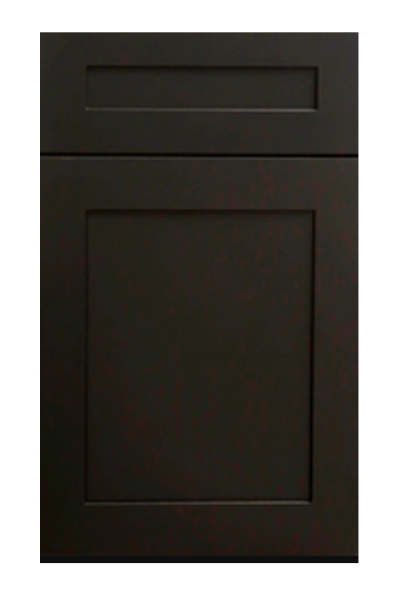
On a pale finish the sheen level is a detail. On black it changes the room. A matt black absorbs light and reads as a solid mass, calm and slightly architectural. A gloss black reflects the room back and doubles every light source, which can be spectacular and is relentless about fingerprints.
In a family kitchen the matt finishes are the easier life. In a display kitchen that is cleaned often, gloss earns its keep.
Dust, first, and sooner than you expect. Fingerprints around the handles. And every scuff along the toe kick and the edge of a base door, because a knock takes a little paint off and the pale material underneath announces itself against the dark.
None of that is a reason to avoid it. All of it is a reason to specify handles rather than push-to-open on the doors that get used most, and to expect a wipe more often than a pale kitchen needs one.
Everything a busy kitchen produces below the counter. Shadow lines, gaps, the slight unevenness where a run meets a wall that is not straight — dark cabinetry swallows all of it, because there is no contrast for the eye to track. That is the practical reason a dark lower run suits an older house, where nothing is quite square.
Wood is the reliable partner, and it is what stops a black kitchen reading as a stage set. A wood island, a wood shelf, a wood hood band — anything that puts a warm material into the room at eye level. Haven Ember or Classic Chocolate both do that without breaking the dark scheme.
For metal, brass warms black and brushed nickel keeps it cool and modern. Polished chrome on black is the hardest to get right and the easiest to date.
One decision people leave too late is which of the two dark bands the room gets. Dark base cabinets read as a plinth and make the room feel grounded. Dark wall cabinets read as a ceiling coming down, and in a room under nine feet they genuinely lower it.
If only one band is going dark, make it the lower one in almost every case. The exception is a room with a very high ceiling, where dark tall units can be used deliberately to bring the top of the room back down to a human scale. That is an unusual problem, and worth recognising when you have it.
A dark kitchen needs its lighting planned, not added. Under-cabinet lighting stops being a nicety and becomes the working light for the counter, because a black wall cabinet above will not bounce anything down. Plan it before the cabinets are ordered, since it changes what happens at the underside of the run.
The second thing worth planning is where the eye rests. An unbroken wall of dark units is heavy; open shelving, a glazed door, or a pale hood in the middle of it gives the room somewhere to breathe. That break is what separates a dark kitchen that feels deliberate from one that feels closed in.
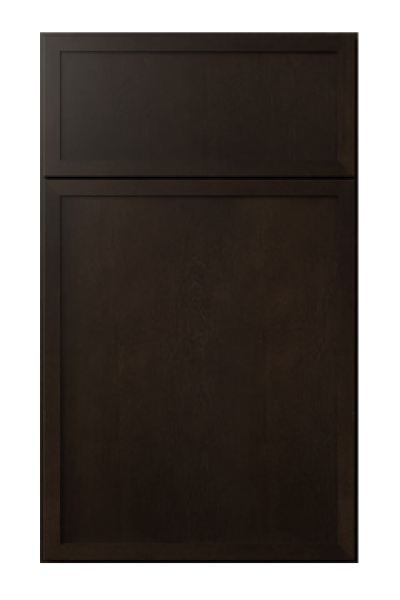
If the room has the light, a full dark kitchen is one of the few schemes that still looks decided rather than fashionable in ten years. If it does not, take the dark to the base run only and let the wall cabinets do the work of the windows — and read where to draw a two-tone line before you settle the split.
All five sit on the Norcross racks. Of everything we stock, a dark door is the one a lit photograph misleads you about most, so it is worth the drive. The range is in the cabinet catalogue.
Every collection below is stocked at our Norcross, GA warehouse for pickup or delivery across metro Atlanta.

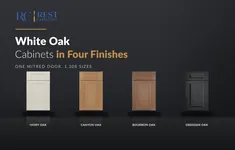

Four finishes on one white oak door: a painted ivory, two stains and a black. What...

Most two-tone pairs are chosen from a photograph. Four of them survive a decade, and they...
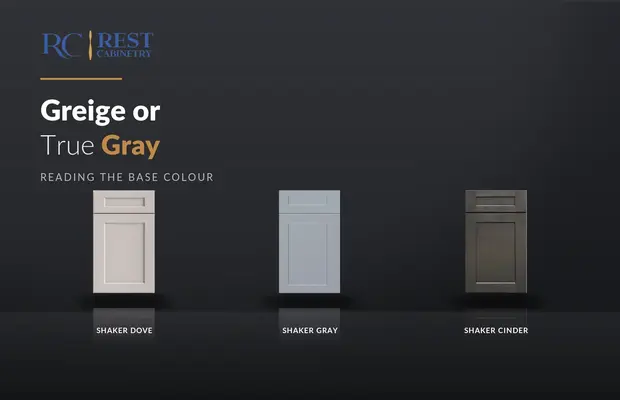
Greige and gray look identical on a screen and behave nothing alike in a room. One...
Log in to see prices and place orders
Don't have an account? Register

