

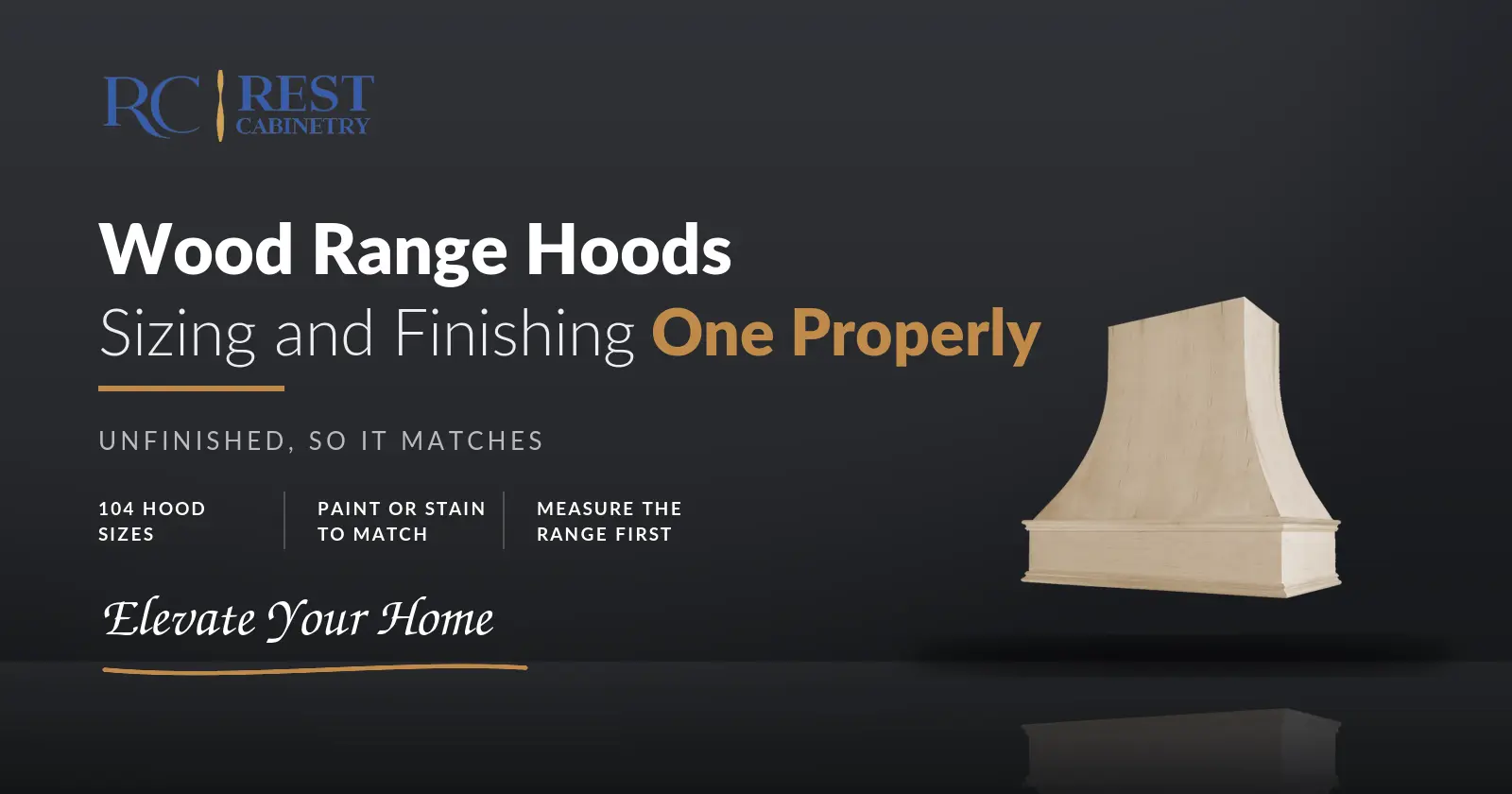
The hood is the only cabinet in a kitchen that people look at directly. Everything else is background; the hood is at eye level, centred on the wall, and lit from below. It is also the piece most often sized wrong, because it is the one whose critical dimension belongs to the appliance underneath rather than to the cabinet itself.
Start with the appliance. The hood must be at least as wide as the range, and wider is better — the extra overhang catches what rises at the edges of the pan rather than only what comes off the middle. A 30-inch range under a 30-inch hood works; the same range under a 36-inch hood works better.
Then the height above the cooking surface, which is set by the ventilation insert you choose rather than by the wood shell. Fix that first, because it determines how much wall is left, and only then decide how tall the visible hood should be. A hood sized to look right on a drawing and fitted at the wrong height looks wrong in the room.
The hood range is built around four shapes, and the shape does more to set the character of a kitchen than the finish does.
Across the four there are thirteen distinct profiles once the mouldings are counted — classic, strapped, shiplap, and banded versions in walnut or maple — and 104 sizes in total. That is more choice in one product than most kitchens need, so narrow it by shape first and moulding second.
Every hood we hold ships unfinished. That is a decision, not a gap in the range. A hood is a large object next to a lot of cabinet doors. If it arrives pre-finished in somebody else’s white, it will be near your white and not quite it, and being near is worse than being different.
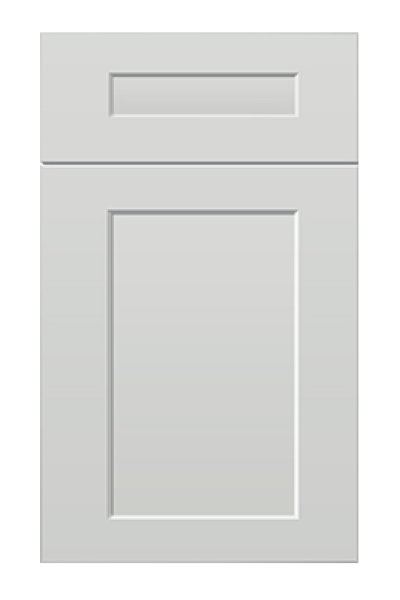
Unfinished means it is painted or stained to match the doors you have actually chosen — Shaker White, Shaker Origami White, Shaker Antique White or any of the rest — using the same finish specification. It is the difference between a hood that belongs and a hood that was bought separately.
The other honest answer is to stop matching. A hood in a wood finish above painted cabinets, or a dark hood above pale ones, turns the range wall into the focus of the room on purpose. If you are going that way, take the hood tone from something already in the room — the island, the floor, a beam — rather than introducing a fourth thing.
Pairing it with a two-tone scheme is the natural extension of this, and the rules for where the line falls are the same: see where to draw the line.
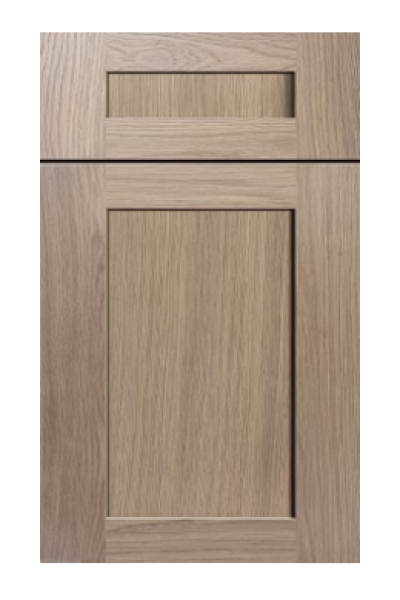
Because the shell arrives bare, three routes are open. Paint it to disappear into the doors, which is what most people do — matched to Shaker Dove, Shaker White or whichever finish the run is in. Stain it instead, the right call wherever timber is already present in the room, and a natural partner for Shaker Cotton Oak or Shaker Natural Wood below.
Or take the third route and let the hood carry a band. Several of the Wilmington profiles are built with a walnut or maple band across the base, which gives a painted hood one line of real timber and reads as joinery rather than trim. Against a dark run such as Shaker Vintage Charcoal or Charcoal Black Shaker, that band is often the only warm thing on the wall, and the room needs it.
The duct is the one people leave until last and it is the one that changes the plan. Establish the route before the shape is chosen.
A hood interrupts the wall cabinets, so the two units either side of it become a design decision rather than a leftover. Equal widths on both sides read as intentional; unequal widths read as an accident even when nobody can say why. If the wall will not divide evenly, a filler on each side is a better answer than one wide cabinet and one narrow one — the size grid covers how that arithmetic works.
Hoods are stocked in Norcross alongside the doors, which is the only practical way to hold a hood profile against the finish you are considering putting on it. The hood pages are at hoods, and the rest of the range in the cabinet catalogue.
At least as wide as the range, and wider is better because the overhang catches what rises at the edges of a pan. A 36-inch hood over a 30-inch range works better than a 30-inch one.
No, and that is deliberate. All 104 hood sizes ship unfinished so the hood can be painted or stained to match the doors you actually chose, rather than arriving in a white that is nearly but not quite yours.
Four families: Asheville curved, Charlotte sloped, Raleigh tapered and Wilmington angled, across thirteen moulding profiles including walnut and maple banded versions.
The wood hood is the shell. The insert is chosen separately, and it sets the mounting height, so decide it before the hood is sized.
Every collection below is stocked at our Norcross, GA warehouse for pickup or delivery across metro Atlanta.


Log in to see prices and place orders
Don't have an account? Register

