


Duluth sits a short run up the corridor from our warehouse, which makes it one of the easiest places in Gwinnett to buy cabinets properly — by which we mean seeing the doors, in daylight, before committing. This is what the local housing stock tends to need.
Our racks sit on Jimmy Carter Blvd in Norcross — 6115, Suite E, zip 30071. From most of Duluth that is a straightforward run down the corridor rather than a trip across the metro, which matters more than people expect: it turns a forgotten filler into an afternoon rather than a second freight charge.
A lot of the housing here went up between the late seventies and the two-thousands, which produces a fairly consistent kitchen: an interior room, one window over the sink, eight-foot ceilings, and walls that were never quite plumb and have not improved.
Three consequences follow, and they are worth deciding before any colour is chosen.
With a single window, the fronts at eye level are doing the work of a second one. Pale wall cabinets return light into the room; mid-tone ones absorb it. That does not mean the whole kitchen has to be white — it means the upper band should be, and the lower band can be anything.
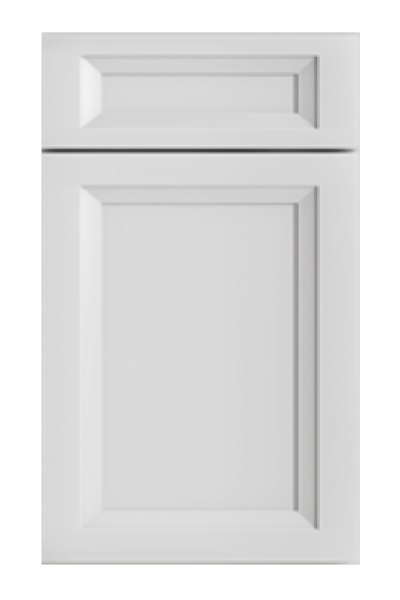
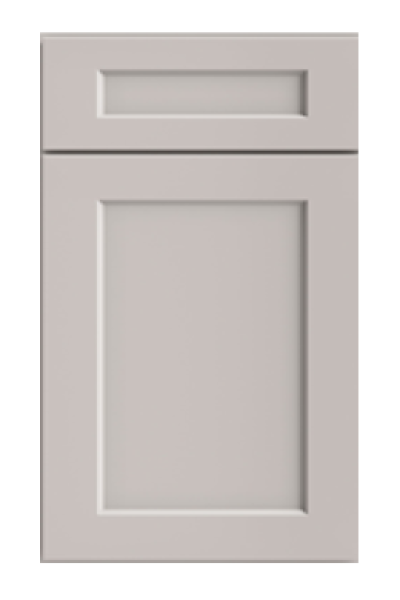
Shaker Origami White and Shaker Dove are the two that come up most for exactly this reason.
At eight feet the choice is a 30-inch wall cabinet with a gap above it, or a 42-inch one running to the ceiling. The gap collects dust and reads as unfinished; the taller cabinet gives storage that needs a step to reach but makes the room look built rather than fitted.
We hold both, along with 36-inch and 18-inch heights, inside a wall range of 7,085 units. Which to use is a room decision, not a stock one — the arithmetic is in the standard size grid.
Where a wall is out of true, a framed cabinet absorbs it quietly and a frameless one does not. In a house of this age that usually points to framed, which is most of what we stock, and away from the frameless European line unless the walls are being brought back to plumb anyway. The comparison is set out in frameless against framed.
Painted whites and warm greys for the perimeter, and increasingly a wood or a dark finish on the island. Shaker Natural Wood under a painted perimeter is the pairing that has moved most in the last two years, and Shaker Dark Gray is the usual answer where somebody wants weight at floor level without going black.
Where an oak floor is being kept, Shaker Antique White settles the warm-versus-cool argument before anyone has it.
With 20,889 separate sizes held here across the nine collections, most Duluth kitchens get picked off the shelf instead of ordered in. For a renovation running to a schedule that is the difference between a week that moves and a week that stalls with the plumbing already open.
Nearly every kitchen of this era has one: the boxed bulkhead running above the wall cabinets, built when 30-inch cabinets were standard and the foot of space above them had to go somewhere. Whether it stays is the biggest single decision in a Duluth renovation and it is usually made by accident.
Taking it out gains a foot of storage and lets the run reach the ceiling, which is what makes a kitchen read as built rather than hung. It also means finding out what is inside it, and in houses of this age that is often ducting or a vent run rather than empty air. Open one small section before committing to the plan, not after the cabinets arrive.
If it stays, the cabinet height is decided for you and the finish carries the whole job — which is an argument for spending the saved money on the door rather than the layout.
In a house of this age the answer is almost never the door. It is the things that make an imperfect room work: fillers and scribes so a run closes properly against a wall that is not straight, finished end panels wherever cabinetry stops in the open, and enough drawer bases rather than door bases in the working run.
Drawers are the upgrade people notice daily and skip at quoting, because a door base is cheaper. We hold 4,942 base units, of which the three-drawer bases are the single largest group — that is not an accident, it is what people order once they have lived with the alternative.
The finishes themselves are close enough in cost that the choice is aesthetic: Shaker White, Oxford White and Classic White are three different rooms at broadly one price.
Three wall measurements per run, taken low, middle and high. Every appliance opening. One photograph in daylight and one at night. And an offcut of whatever is not being replaced — a scrap of floorboard beats every swatch in the building. The method is in how to measure your kitchen, and the areas we cover are on service areas.
Every collection below is stocked at our Norcross, GA warehouse for pickup or delivery across metro Atlanta.


A two-tone kitchen fails in five predictable ways. All five are visible on paper before anything...

Yellowing is a coating problem, not a colour problem. Which means it is avoidable at the...

Suwanee kitchens usually have the two things older Gwinnett houses lack: daylight and ceiling height. Both...
Log in to see prices and place orders
Don't have an account? Register

