


Finish is the decision people spend longest on and think about least carefully. Almost all of the attention goes to how it looks in the picture, and almost none to how it behaves after a decade of wet hands, hot pans and a dishwasher door opening under it twice a day. Both matter, and they pull in different directions.
A painted finish is an opaque colour over the door; the grain is covered. A stained finish is a transparent colour that darkens the wood and leaves the grain showing through. A natural wood finish is a clear protective coat over the timber, changing as little as possible.
Everything else — glazes, distressing, two-step colours — is a variation on one of those three.
Most of what we hold is painted, and it is where the colour range lives. Whites from Shaker White through Shaker Antique White, greys from Shaker Dove to Shaker Vintage Charcoal, and colour where you want it in Escada Midnight Blue or Shaker Jade Green.
The practical advantage is repair. A chip in an opaque colour can be filled and touched in and genuinely disappear, because there is no grain pattern to match. That is not a small thing over fifteen years in a family kitchen.
The disadvantage is that paint sits on a surface rather than in it, so a hard knock on an edge shows as a light mark against a dark colour. On pale paints this is nearly invisible; on charcoal it is not.
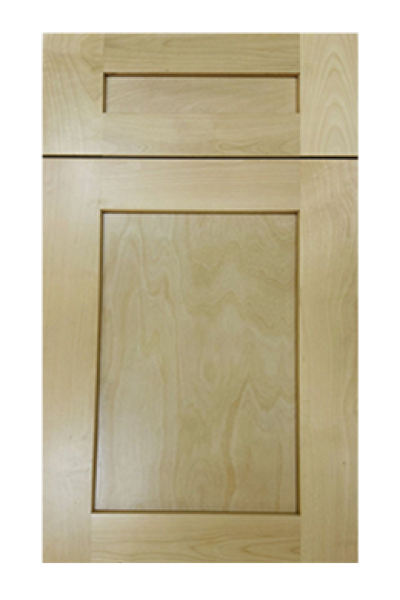
Grain is camouflage. Fingerprints, small scratches and the general wear along a drawer front are simply less visible on Shaker Cotton Oak or Shaker Natural Wood than on a flat colour, because the eye is already busy. In a house with children this is a real, daily advantage.
The cost is matching. Timber varies board to board, so two doors from the same finish will not be identical, and a replacement door ordered three years later will be close rather than exact. If that would bother you, this is the wrong family. If it reads as character, it is the right one.
Darker woods such as Obsidian Oak and Casselberry Saddle hide wear best of all, at the cost of the light they absorb.
A kitchen with one window cannot afford a dark finish on every surface, whatever family it comes from. In that room the useful move is a pale painted upper band with whatever you like below, so the reflective surfaces are at eye level where the light is needed.
A room with two good windows can carry a wood or a mid-tone across the whole kitchen and will look better for the warmth. The mistake is treating the finish decision as independent of the window count, which is how a beautiful sample ends up in a gloomy room.
In rough order, from most forgiving to least: mid-tone wood grain, pale paint, dark wood, dark paint, high-gloss anything. Gloss is last for a reason — a mirror surface shows every fingerprint and every straight line that is not quite straight. It can look extraordinary, and it asks for a wipe far more often than a matt finish does.
A glaze is a thin dark coat worked into the profile and wiped back off the flat areas, so the moulding lines read more strongly. On Princeton Creamy White Glazed that is what separates it from a plain cream: there is depth in the corners that flat paint cannot produce.
Distressing does the opposite job. It puts wear into the surface deliberately, so that later, real wear has nothing to add. Shaker Stone Wash and Casselberry Antique White both work that way. Whether you like the look is taste; the practical effect is real, because a kitchen that already reads as lived-in does not visibly age.
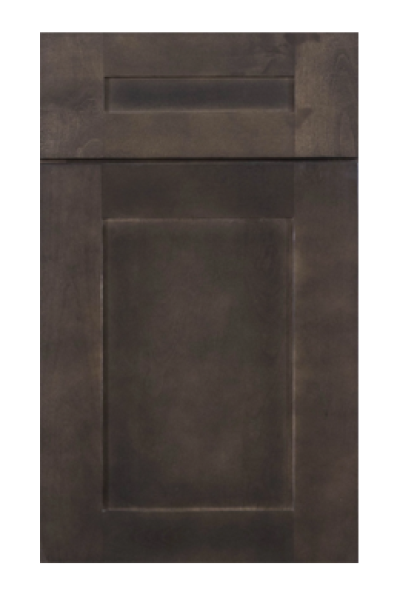
If the kitchen finish is going to reappear in a laundry, a bathroom vanity or a bar, choose a finish held across enough sizes to cover all of it in one go. Ordering the same finish in two batches a year apart is where matching problems begin, and it is worth pulling the whole house into a single order for that reason alone.
Ask which failure you would rather live with: a mark you can touch out but will always know is there, or a mark you will never notice but could never match if you tried. Painted is the first. Wood is the second. Almost everything else follows from that one answer.
Then check the answer against the room rather than the sample. Count the windows, look at the floor you are keeping, and be honest about how the kitchen is used — a household that cooks every evening wears a finish differently from one that does not. A finish chosen for a photograph and a finish chosen for a room are rarely the same finish, and only one of them is still right in five years.
Doors from all three families are on the racks in Norcross, and holding a painted and a wood door in the same daylight for one minute answers this faster than any amount of reading. Start from the cabinet catalogue, or from the white guide if paint is already settled.
Every collection below is stocked at our Norcross, GA warehouse for pickup or delivery across metro Atlanta.


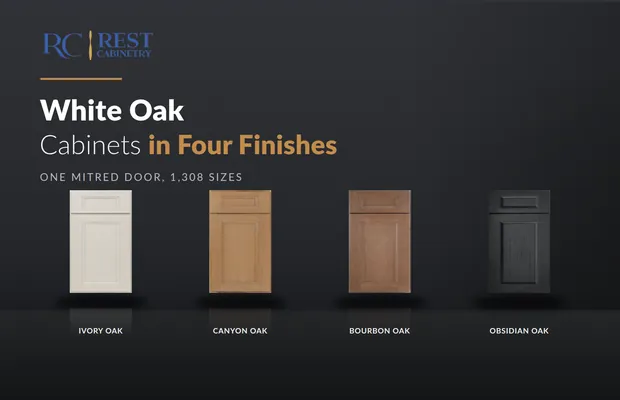
Four finishes on one white oak door: a painted ivory, two stains and a black. What...
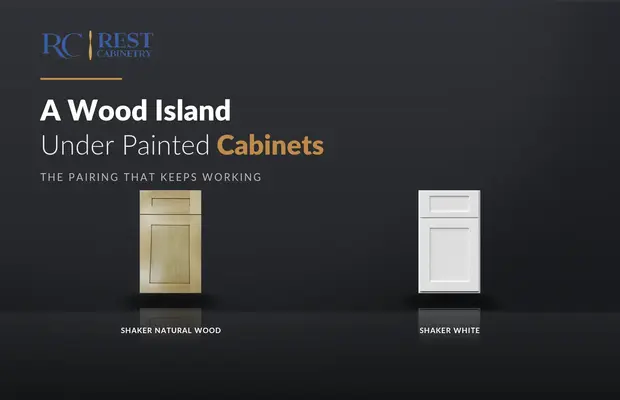
Wood on the island is the two-tone that people who dislike two-tone kitchens still like.
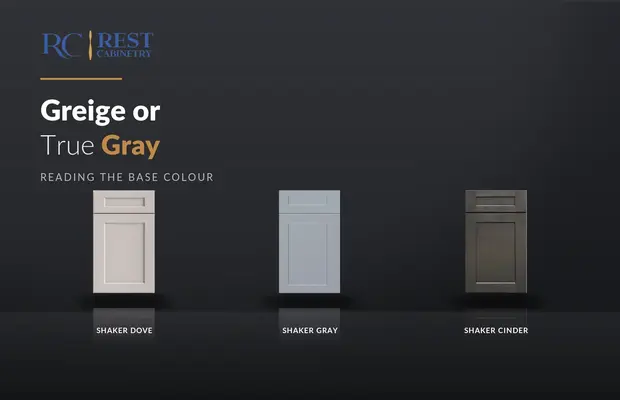
Greige and gray look identical on a screen and behave nothing alike in a room. One...
Log in to see prices and place orders
Don't have an account? Register

